In development. Not yet released.
Shop management that understands an engine build
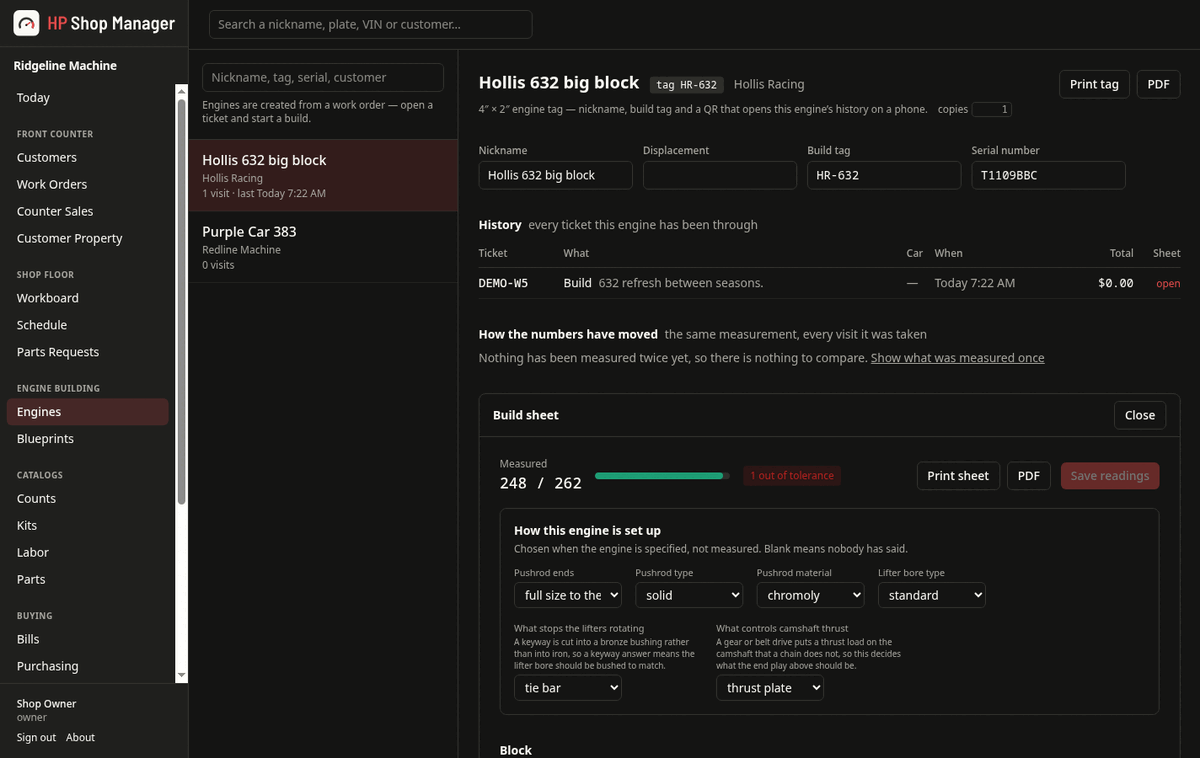
Most shop software treats a rebuild as a work order with a lot of lines on it. This one treats it as an engine: a block with a serial number, positions that get measured, tolerances that pass or fail, and a build sheet the customer keeps.
- Runs on a PC in your building. Your data does not live in someone else's datacentre.
- One installer. Pick whether a machine is a workstation, the server, or both.
- Estimates, work orders, invoices, parts, purchasing, scheduling and time — one program.
See what it does
Engine building
The part that is actually different.
Blueprint specs and measurements
Per-position readings — every journal, every bore — against the spec for that build, with pass or fail on the number rather than in somebody's memory. Out of tolerance is a glyph and a weight as well as a tint, because the shop printer is a black-and-white laser.
Built and checked:
HPSM-011 HPSM-012
Build sheets the customer keeps
A printed record of what was measured and what it came to. The document is the deliverable on a $14,000 rebuild, and it prints from the same data the shop worked from — not a summary typed up afterwards.
Built and checked:
HPSM-013
Engines are things, not fields
An engine has a nickname, a serial number and a history that outlives any one ticket. It comes back three years later and the shop can see what was done to it, by whom, and what the bores measured.
Built and checked:
HPSM-010
Running the shop
The parts every shop needs, done properly.
Estimate to invoice, with the rules enforced
Estimate, approval, work, invoice, close — and the transitions are enforced by the server, not by hoping. A ticket cannot be invoiced with a clock still running on it.
Built and checked:
HPSM-001 HPSM-004
Prices frozen when the work was agreed
The tax rate, the discount and the price group are snapshotted onto a document when it is written. Changing a rate next year cannot rewrite what a customer was quoted.
Built and checked:
HPSM-003
Multi-state sales tax that files
A stack of jurisdictions with their own rules — state, county, city, transit — each taxed on its own base and rounded once, because that is how a return is filed. Exemptions are a reason, with the certificate on record.
Built and checked:
HPSM-060 HPSM-061 HPSM-062 HPSM-067
Today, when you open it
One page of cards: what is promised this week, what is finished and still on the floor, what is below minimum, what the floor asked for that nobody ordered. Drag them into the order you want; each role starts somewhere sensible.
Built and checked:
HPSM-087
Parts and buying
Stock that adds up, and suppliers you can argue with.
Costs from a ledger, not a guess
On-hand and average cost are replayed from an append-only movement ledger, so the shelf value and the parts screen cannot quietly disagree. Counts adjust through the same ledger.
Built and checked:
HPSM-006 HPSM-030 HPSM-039
The stock report is the purchase order
What is below minimum, grouped by supplier, ready to become an order. A shop should not be re-typing a buying list it already has.
Built and checked:
HPSM-018 HPSM-019
What the supplier actually charged
Enter the bill and see it against what was ordered. The $4,090 order that arrived as a $4,180 invoice is nobody's job to notice, which is exactly why it goes unnoticed.
Built and checked:
HPSM-045
Core deposits, both directions
Charged with the part, credited when the old unit comes back, and chased from the supplier when it goes the other way — joined on the physical object rather than on two separate hopes.
Built and checked:
HPSM-042 HPSM-070 HPSM-071
Money
The month, in the bookkeeper's terms.
Statements a customer can follow
A ledger, not a stack of photocopied invoices: balance forward, what was charged, what was paid, what is due — tying to the receivables report to the cent, which is checked rather than assumed.
Built and checked:
HPSM-044
An accounting export that balances
Sales, payments and supplier bills as journals, with the debits and credits proven equal before the file is handed over. Your chart of accounts, not ours.
Built and checked:
HPSM-036 HPSM-045
Yours to keep
On your hardware, with the boring things done.
It is your database
PostgreSQL on a machine in your building. Backups run on a schedule, and the restore is rehearsed rather than hoped for — an untested backup is a rumour.
Built and checked:
HPSM-025 HPSM-034
Nothing stored in plain text
Staff passwords are hashed and never recoverable. Secrets the server has to present — a mail password, an API key — are encrypted with a key that is not in the database, so a stolen backup carries ciphertext and nothing that opens it.
Built and checked:
HPSM-080
Who changed what
An audit log over the things worth arguing about later, and a save that would erase somebody else's work is refused — naming who changed it and when.
Built and checked:
HPSM-035 HPSM-046
Questions
Is this hosted, or does it run here?
It runs on a PC in your shop. The server and the database are yours, on your hardware, on your network. A hosted option is planned for the things that have to reach outside the building — emailed links, off-site backups — and the on-prem product will stay the product.
What does it run on?
Windows, with a single installer that sets up the database, the service and the firewall rules. Linux is supported for the server. macOS is a client story and is not finished.
Can I get my data out?
Yes, and without asking anyone. It is a PostgreSQL database you own; the accounting export and every report also write CSV.
What does it cost?
Not decided. Nothing is released yet, so there is no price to quote and no point pretending otherwise.
Can I try it?
Not yet. There is nothing to hand out until the first release.